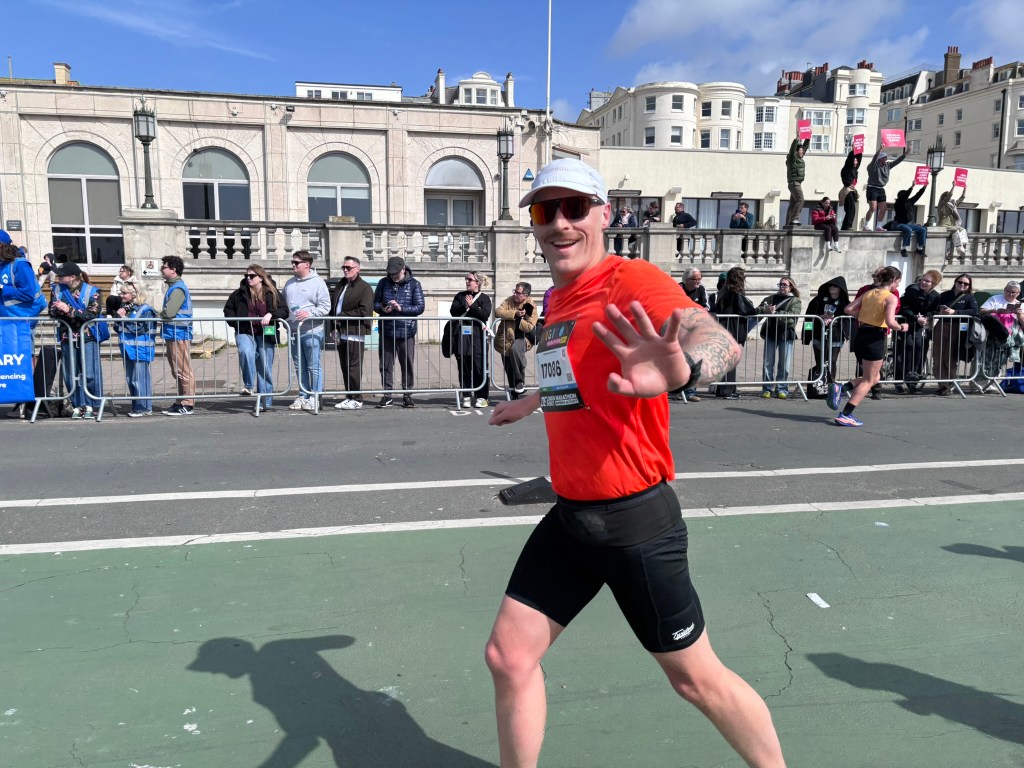
After ten years and twenty-one ultra-marathons I finally toed the line at my first road marathon – The Brighton Marathon which I completed in 3:02:30.
Why now? I’m looking for speed. To get faster at ultras I need to get faster in general, and that means building a strong foundation at the shorter distances. The road marathon is perfect for bridging the shorter faster distances and ultra. I am also genuinely curious to see how hard I can push the pace over the marathon distance, based on my training and previous half marathon times (my PB is currently 1:27:20) I thought I had a real shot at a sub 3 hour time.
Training structure
Compared to most of my ultra training blocks so far, this marathon block has had the most structure, with very specific sessions on set days in the week, each session is important and supports the sessions on the days around it.
Preparing for Brighton has required 20 weeks of very specific training with a large amount of running at marathon pace (4:15/km). For a long time, my ultra training has been focused on maintaining a slower consistent pace over long distances, variable terrain, and elevation changes, and is usually more forgiving about how I structure the weekly runs, largely because the majority of my runs have been at an easy pace.
This marathon training block has taught me the importance of variance in training sessions for overall running improvement. I will be keeping one interval session, one marathon pace session, and one weight lifting session — alongside the existing double long days, as mandatory in every ultra training block going forward.
The “bonk”
If you “bonk” in a marathon it is very unlikely you will recover. Bonking is when your body “hits the wall”, whether through inadequate fueling, poor electrolyte management, or muscle weakness; the body is suddenly unable to keep moving at marathon pace. This happened to me at about 34 km, my pace slowed by 30 seconds per kilometer for two kilometers. I recovered slightly, but could not get fully back to marathon pace after this.
In ultra races the distance, terrain and elevation will usually force me to run at a more conservative pace. This allows more time to properly manage my fueling. I typically wear a hydration vest which holds more fluid, fueling, electrolytes and anything else I may need, so I can take it exactly when I need it. I do not usually bonk in an ultra race. It is usually a slower rate of, largely manageable, full body fatigue that sets in towards the back end of ultra races. I slow to a shuffle with heavy, sore legs and struggle to concentrate as time passes.
Pacing and fatigue
I got my pacing wrong from very early on. I had planned to run the first 5 to 10 km ten seconds slower than marathon pace and progress from there, but instead I started at 5 to 10 seconds quicker than marathon pace and stayed there for most of the race, even whilst running up the hills. It’s no wonder I bonked. The trap of feeling so good after a successful, injury-free training block and taper, tricked me into thinking I could run faster than 20 weeks of training said I was ready for.
It is very difficult to maintain a consistent pace in an ultra. The numerous changes in terrain, elevation, weather conditions, day vs. night, and time-on-feet all force changes in pace. A measly 6:30/km pace at altitude, climbing up yet another steep hill, or at 85 km into a 100 km route, may be considered fast in the context of the overall race.
All the above conditions also ensure that my body is constantly changing the parts of the body it uses to keep moving forward. Climbing gives the muscles I use for faster running a chance to recover, and vice versa. But, of course, you must be strong in all the different ways of running to be successful in an ultra race. The road marathon is a constant, repetitive impact on exactly the same muscle groups, at high intensity, for 3+ hours straight. No relief for the entire time.
Fueling
In the marathon fueling came naturally. Every 20 minutes or so I would swallow some more carbohydrate gel out of the 90g PFH pouches I was carrying. I did not take any electrolytes during the race, and I think that may have been part of the cause of my decline towards the end. I was relying on having drunk a bottle of electrolytes just before the race, which I think was a mistake.
I lost about 3kg of weight during the race. I’m sure I did not drink enough water which is probably the other reason for the late decline.
The festival of running
The atmosphere at the Brighton marathon was incredible. People lined the streets, cheering us on, for most of the course. There were lots of sections where people were singing, playing drums, and playing music to encourage us.
The sheer number of runners around me at all times was amazing to be a part of and running in a large pack with all the spectators around really felt like it gave me a boost to keep pushing the pace.
It really felt like the city had come alive, the energy was electric. Like a celebration of the city, its people, and running.
Switching off
I was largely able to switch off. The only times I really had to pay attention was when I was collecting water, as there were other runners around me and some that slowed down suddenly, which I had to be careful of. Other than spotting my family in the crowd and keeping out of a slight head wind, there wasn’t much I needed to think about.
In ultra races it is actually possible to get lost. The distances between aid stations or any sign of life, for that matter, can be vast. The routes can be unsigned, and the weather so bad, that you have to self-navigate by map, or more commonly, watch GPS.
In ultras you have to constantly pay attention, to your body, to where you are putting your feet, to what you are going to do at the next aid station, to what you are wearing and if you need to add or remove layers, do you have enough nutrition to get to the next aid station? How do you pay attention to where you are going in the middle of the second night, deep into sleep deprivation, with nearly zero visibility, except for the hypnotizing cone of light coming from your head torch?
This is a large part, aside from the sheer physical exertion, that makes ultras mentally, as well as physically, exhausting – why even completing many of them is an achievement in itself.
The marathon is a special distance and it deserves the respect it gets. It is considered the furthest distance of pure athletic endurance ability, and it took me right to the edge of my own capability. Beyond it, though, lies something completely new, something beyond just the physical, something different, that isn’t easily comparable, it isn’t easier, it isn’t harder, it is more, more physical variance, more logistical puzzles to solve, more natural beauty. It can be more spiritual, more scary, and even more bizarre at times. It is more than just running.


Leave a comment