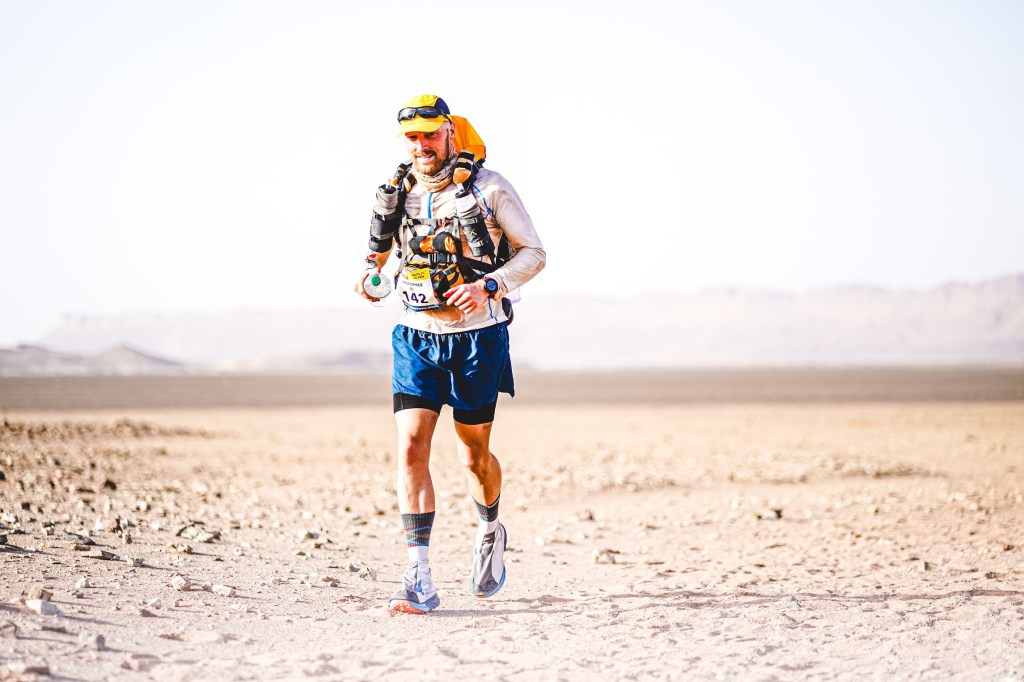
This is the first in a series of posts documenting my experience completing the 38th edition of the Marathon des Sables—one of the toughest footraces on Earth.
Origin story
The Marathon des Sables (marathon of the sands) is a six-stage, 252 km (157 mile) ultramarathon race held every year in the Sahara Desert, in southern Morocco.
It was the brainchild of French concert promoter Patrick Bauer. In 1984 Patrick embarked on an epic solo trip across the Sahara Desert, on foot, as a personal challenge to test himself and immerse himself in an extraordinary experience. He was fully self-sufficient, carried all his own equipment, and covered 350 km (214 miles) in 12 days. Patrick’s achievement showcased the potential of human endurance and self-reliance, which became the foundational spirit of the MdS.
The first race was held in 1986 with only 23 competitors, fast forward to 2023 this number has grown to over 1,000. Since its inception, over 25,000 runners have competed in the race.
The toughest foot race on earth
What makes the MdS the toughest foot race on earth, you might ask?
The heat
The desert conditions are extremely harsh and the heat very intense as you climb rocky jebels and traverse challenging salt flats and sand dunes.
During my 2024 race, initial weather forecasts predicted temperatures in the mid-30s Celsius. However, under the scorching midday sun during the marathon stage, with no wind and while navigating the sand dunes, temperatures reached 50 degrees Celsius.
Self-sufficiency
The MdS is a self-sufficient race, meaning you must carry all your own equipment and food for the entire event, in a backpack weighing between 6.5kg and 15kg. Only communal bivouac’s and water are provided by the organisers.
Attrition
The compounding effect of multiple stages of running takes its toll. As the days wear on, you become more tired as you survive on less sleep. Each day your body requires more calories yet you are less able to consume any food. Every day you are dirtier, having worn the same clothes for multiple days. There are only very basic toilets, no showers and no running water, or any other home comforts.
It may not be the most challenging pure running race per se, however, in my opinion, it is the toughest test of being extremely uncomfortable for an extended period of time.
You don’t need to be exceptionally fit to complete the Marathon des Sables but you do need to be able to endure the mental and physical attrition and keep moving forward, day after day.
Me and my why’s
So, who would willingly undertake such an extreme feat?
As Noël Coward wrote “Only mad dogs and Englishmen go out in the midday sun.”
Whether it’s taming your inner demon or pushing your body to its absolute limit, everyone has their “why”.
Mental health
Running helps me manage my mental health challenges. Men often struggle to find effective ways to manage their mental well-being. In the UK, mental health issues among men have reached crisis levels.
According to the Office for National Statistics:
- Men are three times more likely than women to die by suicide.
- Suicide is the largest cause of death for men under 50
- Men aged 40-49 have the highest suicide rates in the UK.
- Only 36% of referrals to NHS talking therapies are for men.
I started running ten years ago, initially to get fit and lose weight. But I quickly noticed something unexpected: the more I ran, the calmer and happier I felt. Running became a mental reset button, a way to clear my head and find stability.
Before long, I was running half marathons regularly. But as the half-marathon distance became comfortable, I wanted more. That’s when I discovered trail running, and later, ultra running.
Ultra running is usually described as any run further than the Marathon distance (42.2km). Typically, these races are run on trails, in remote and mountainous regions, where there is beautiful scenery and lots of fresh air.
The passion
From the moment I set foot on the trails, I was hooked.
Ultra running isn’t just about covering distances beyond the marathon’s 42.2 km. It’s about adventure—running through remote, mountainous regions, breathing in fresh air, and being surrounded by stunning scenery.
Races feel like expeditions, filled with epic landscapes, aid stations stocked with food, and interesting people who share the same hunger for challenge.
Yes, it’s physically brutal—but that’s part of the fun.
And like anything truly addictive, I crave more. Longer distances. Tougher terrain. Harsher conditions.
I signed up for the Marathon des Sables to test my limits—not just physically, but psychologically.
Would it change me, as it has changed so many others?
Would my life feel different—pre-MdS and post-MdS?
Personal growth
There’s another layer to my pursuit of suffering: perspective.
There is also an element of re-balancing my perspective of the life I live. As a relatively comfortable, middle class, white English male. Everything feels easy and efficient and safe and average.
I have had no wars to fight, no financial worries, no real hardships. I do not suffer enough.
I recognize when I’m deep in the pain cave—that place where exhaustion, hunger, and discomfort consume you. But I don’t fight it. I embrace it. Because I know that on the other side of suffering lies gratitude.
When the race ends, I return home to my family and comfort with a renewed sense of appreciation. Ultra running rebalances me. It humbles me. It reminds me of what truly matters.
Charity
On this occasion I took the opportunity to take part on behalf of the charity Hope for Children (aka. Chance for Children). Fundraising is not something I’ve done before, but given the high profile of the Marathon des Sables I thought I would try to raise £1000.
With a lot of help from my partner, in total we raised £1,030 from the following donator’s:
Em #2, Becca, Ronnie Kullick, Monica W, Bhav, Melissa Rockman, Digger, Rich O, Andrew and Helen, Charlotte Silcock, Jonathan Harrison, James Elsey, Chris Marshall, Sarah and Robert, Kirstie and Steve, Marcin, Sundhari Ramasubbu, Darshan Gajera, Dee Cahill, Joe Gallant, Sheila and Conrad, Alison Oatey, Michael Downey, Eleanor Rayden, Mark Lanham, Amy Bellamy, James Harrison, Victoria Watson, Rob and Eve Mepham, Lorna, Robin and Nanny Jean Mepham, Ian Mepham, Kuba, Charlotte Nash, Matthew Nash, Ryan, Bridget and David, Emily, Teresa.
Thank you all so much for your kind donations.
Preparation and training
The journey to the start line of the Marathon des Sables is a big challenge.
The cost
I first committed to MdS in June 2023, signing up on the official website and paying the first of five large monthly instalments. Before that, I had spent months casually researching, gradually convincing myself that the 2024 (38th) edition would be my race.
The first hurdle wasn’t physical—it was financial.
Entry alone costs a significant sum. But I justified it as an investment—not just in a race, but in a once-in-a-lifetime, potentially life-changing experience that few will ever undertake.
Beyond the entry fee, the true cost of MdS adds up fast.
Between specialist kit, medical checks, food, and MdS-specific training (including heat acclimation, sun exposure, and ECG tests), I estimate my total spend was around £7,000.
Expensive? Yes.
Worth it? I was about to find out.
You can read about the kit I used here.
The training
My training plan was just nine weeks—far from ideal.
I had to take a couple of months off at the end of 2023 to recover from a left knee injury, which meant I missed valuable training time. Ideally, I would have had at least 12 weeks to prepare, but I accepted that I’d be lining up at MdS undercooked.
That said, I wasn’t there to compete—I was there to complete.
My Training Focus
To maximize my short training window, I focused on a mix of strength, endurance, and heat adaptation:
- Strength Training
- Stairmaster sessions with an 8kg weighted pack
- 25kg weighted lunges
- Leg curls for knee strength and stability
- Swimming
- One 2km swim per week to maintain aerobic fitness with minimal impact
- Back-to-Back Weighted Runs
- Long, slow-paced runs carrying 7-9kg
- Double and triple back-to-back run days every other week to build fatigue resistance
- Hybrid Outdoor & Treadmill Runs
- Example: 22 km outdoors, then switch to a treadmill until 28 km to reduce impact but maintain mileage
- Daily Training, Smart Recovery
- I trained every day to condition my body to constant movement
- But I structured my sessions carefully—for example, scheduling a swim or short run the day after a heavy weights session to prevent burnout
The Sacrifice
I signed up for the Marathon des Sables knowing that my partner was pregnant.
By the time I left for the desert, our daughter was just two months old. I was vanishing for 10 days at one of the most critical times in her life.
The guilt was overwhelming. And it still is.
A Difficult Decision
My partner supported me completely. She knew that this had been a dream race of mine for a very long time. She understood that I needed to do it—not just as a physical challenge, but as a mental reset. A way to close the chapter on difficult events in recent years.
But that didn’t make leaving any easier.
Every day in the desert, I allowed myself a quiet moment to cry. I missed her and my baby so much.
At some point, I made a promise to Frida—one I’ve repeated, half jokingly, since returning home:
“I will never leave you for more than a weekend until you’re at least 22 years old.”
The Time Commitment
The race didn’t just take 10 days away from my family—it took months.
Physically, I spent countless hours away from home, running, lifting, training.
Mentally, I was even further away—researching, planning, packing, re-packing.
My life revolved around MdS preparation, often at the cost of being truly present at home.
Thankfully, working from home three days a week allowed me to be more available than most. But still, the sacrifice was real.
And now, having crossed the finish line, I understand the true cost of chasing this dream.
Start the Admin Early
One of the hardest parts of preparing for MdS was knowing when I was “ready.”
There were countless tasks to complete, and while some were obvious, others only became clear as I dived deeper into preparation. The earlier I started, the better.
Here are some of the most critical tasks I tackled:
1. Structuring My Training Plan
Having run long distances for years, I was confident in designing my own training plan with only a few MdS-specific adjustments:
- More weight training to strengthen my legs and core
- Running with a weighted pack to simulate race conditions
- Balancing intensity and volume to peak at the right time
2. Gear & Food Prep
- Ordering, testing, and adjusting gear—making sure everything was race-legal, efficient, and light
- Decanting food to save weight and make it easier to carry
- Fine-tuning my pack setup so that everything was easily accessible during the race
3. Medical Requirements
MdS requires an ECG and doctor’s approval within one month of the race.
I was fortunate that Rory Coleman (a veteran MdS competitor with 17 finishes) organized two dedicated medical days where runners could visit him and his doctor brother to get both the ECG and medical form completed in one go. This saved a lot of hassle.
Why Starting Early Matters
Getting ahead on these tasks significantly reduced stress and boosted my confidence. With so much to think about, the last thing I wanted was a last-minute scramble.
 Chris runs ultras
Leave a comment