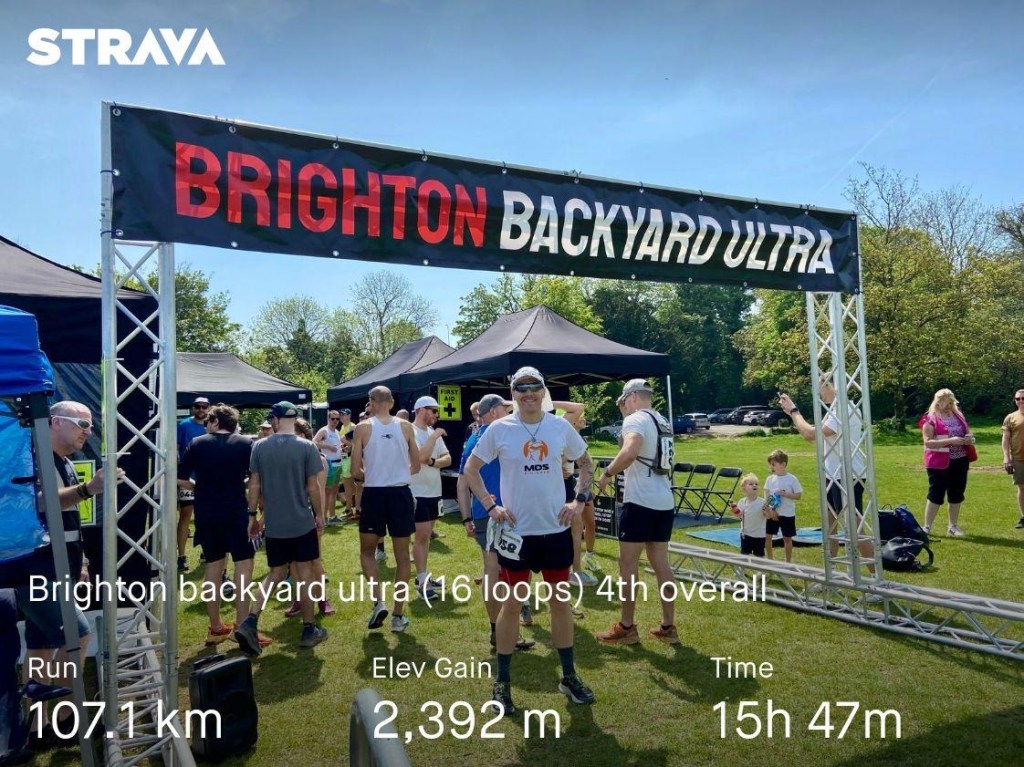
This race came out of the blue. I discovered it by chance when I was running in Stanmer woods and saw a sign stapled to a tree advertising it.
Participating in this race was risky as it meant leaving only two weeks to recover until my next race, London to Brighton (a 100k point-to-point race).
It being a backyard ultra meant I could choose how many loops I completed, as such I initially treated it as a long training run. However, this soon changed. I worked out that completing 16 loops would be the longest distance I have ever run at 107.2 km. I proceeded to obsess.
My body was in good shape, I felt fit, even though I was just four weeks removed from completing the Marathon des Sables.
What is a backyard ultra?
The backyard ultra (or last man standing) is a relatively new format in ultra-running, created by Gary “Lazarus Lake” Cantrell, who created the first race, Big’s backyard ultra, in his own backyard, in 2011.
A runner must complete a looped distance of 6.706 km (4.167 mi) in 1 hour. It is this distance because it totals 100 miles completed in 24 loops (“yards”) in 24 hours.
A runner must complete a full loop, and be ready to start the next loop, on the hour, every hour. 1 hour allows a minimum pace of 14.4 minutes per mile, or 8.9 minutes per km in order to complete a loop on time and be ready to start the next loop.
There is only one winner in a backyard ultra race and that is the last person standing. It is the runner that completes a final loop on his/her own after all other runners have dropped out or DNF’d (did not finish). The last person to DNF is referred to as the “assist” as he/she helps determine the number of loops that the winner must complete in order to win. There is no second or third place medal.
My strategy
Having decided that I would like to target achieving a new distance PB, I’d thought up a couple of strategies that I could choose to use (or not) depending on how my race was going.
The race started at midday, which meant that in order to achieve my goal I would be running through the night and hopefully complete 16 loops at 4am.
One strategy would be to complete a loop in 45 mins and 30 secs, which meant I had to maintain an average pace of 6:30/km. This would allow me 14:30 mins to change any clothing, top-up a bottle, consume some food, stretch, sit with my feet up etc. and have 30 seconds to get inside the corral, ready for the next loop.
Another strategy was to do a lot more walking and average a 8:30/km pace so that I would complete a loop in approximately 59 minutes. This strategy could be useful if I felt good and wanted to delay an “admin” loop to every second loop or more.
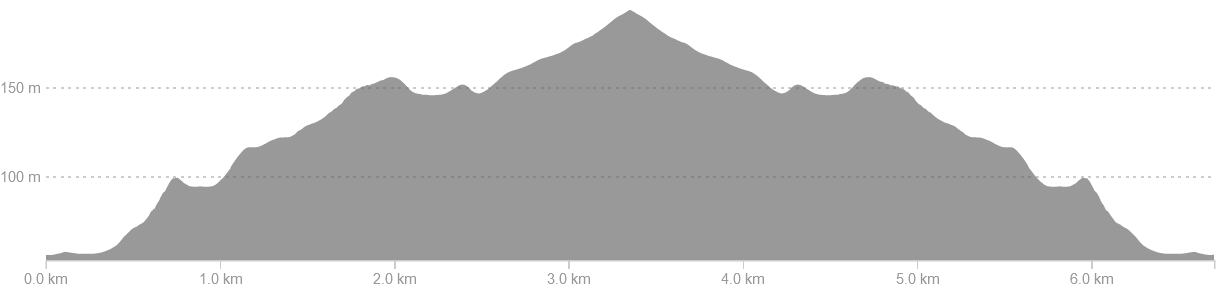
One consideration was the ascent of each loop. At 166m, almost all of the ascent must be climbed in the first half of the loop. I had recently recced the loop and timed the return leg at 20 minutes (on fresh legs), this left 24:30 mins to complete the climbing, alot of which was not runnable, and quite technical.
Because of the looped format of the race, I was able to setup a pitch, which consisted of two reclining camping chairs, a large parasol, a cooler box, a large box full of nutrition and medical gear, and a large bag of spare clothing, shoes, and warm gear for the night running.
I had prepared two large hot thermos flasks, so that I could have:
- 1 litre thermos flask containing 2 large decanted Beef pot noodles, with half a beef oxo cube (for the added salt)
- 1 litre thermos flask containing 4 sachets of decanted hot chocolate, totalling 2000 calories.
- 1 half litre thermos of strong coffee
I had also prepared a cooler box, which would contain:
- 4 cans of coke
- A pint of milk
- Chocolate nut bar
- Homemade flapjacks
- Chocolate digestive biscuits
- Two 750ml bottles of protein shakes, already made up
- Jelly Babies
- Salty pringles
- 1 pepperoni pizza
The rest of my nutrition options consisted of my usual running items such as High5 gels, High5 tablets, Precision fuel and hydration carb gels and chews, and Tailwind. None of which I ended up using.

The yards
The course is an out-and-back that starts in the fields of Stanmer park and heads up for about 1km before entering the woods, which you stay in, and run straight until the turn around point. A beautiful location.
The first half of the course is nearly entirely (166m) up hill. The entire course is on fields or soft compacted woodland trails.

This was the best race I’ve had to date. My body turned up and my mind and body stayed strong all the way to the end of my last loop. I finished feeling like I could carry on for many more loops.
I felt a sense of euphoria as I ran uphill into the woods on one of the later loops, thinking that I felt better now then I did on loop one.
I remember thinking: How can I possibly be feeling this good 12 hours into an endurance run?
I started the loops relatively conservatively, always at the back of the pack, always walking the ups and plodding the flats and downs. The first half of the loops I completed with 8 or 10 minutes spare for admin. Just enough time to consume a mix of Pizza, salty crisps, coca-cola, electrolyte drink, milk, Hot chocolate, coffee, beef noodles (with added stock) and to roll out my back and stretch my hips.
I think I was consuming the nutrition very well. The correct quantity, the correct variation, the correct consistency.
This was the first race I got a true sense of the direct correlation between nutrition consumed and energy produced. I fealt like I was eating my way to success.
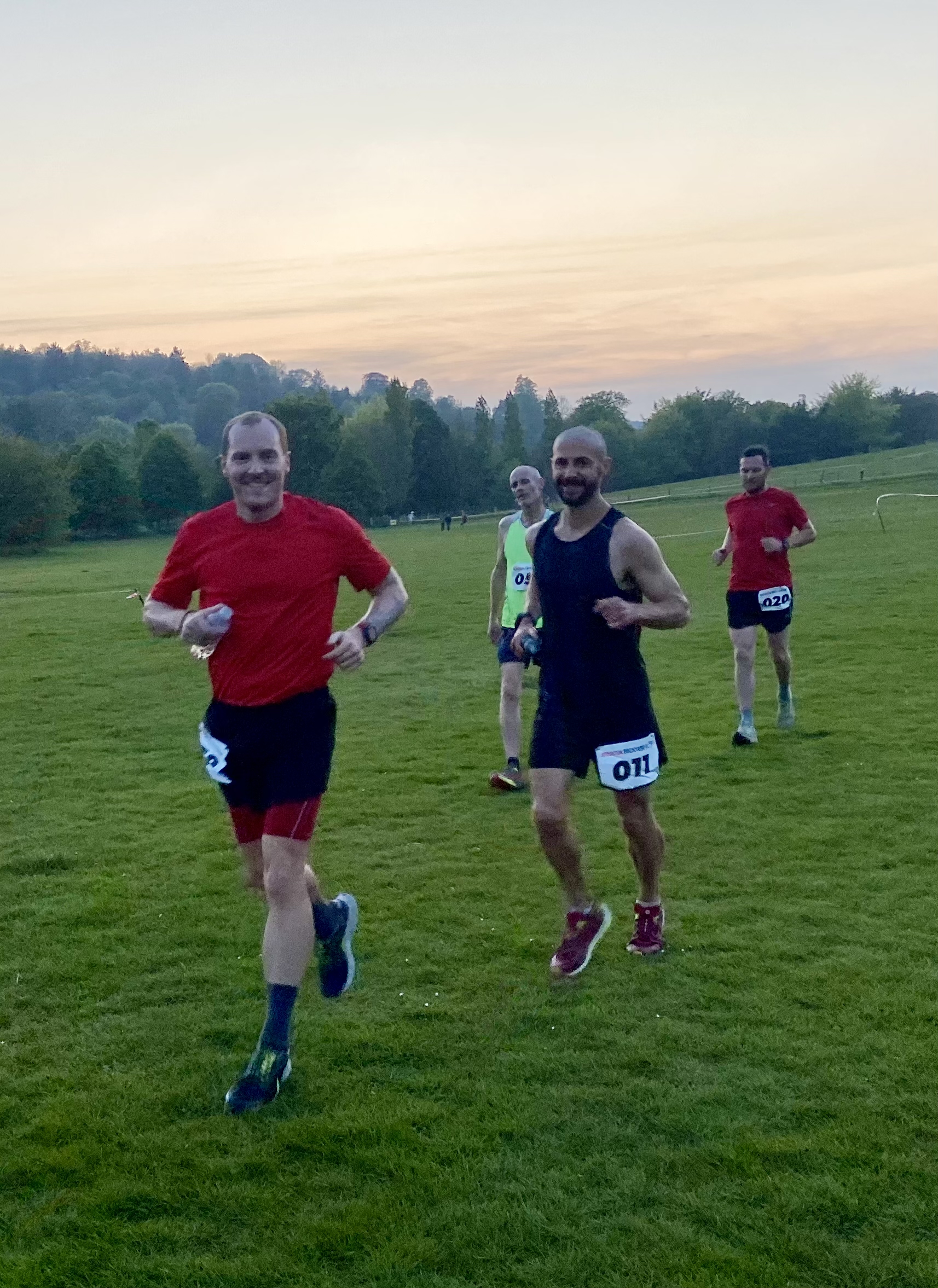
I had a Zee! We met at the back of the starting corral on loop 1 and were pretty much inseperable for the entire race after that.
A sub 2:38 marathon runner with some ultra pedigree; Zee was happy to stick at the back of the pack and talk away many of the loops with me.
Buddying-up like this, especially where it felt effortless and not a chore to talk, is rare for me in ultra-races, so I feel very lucky to have met him.
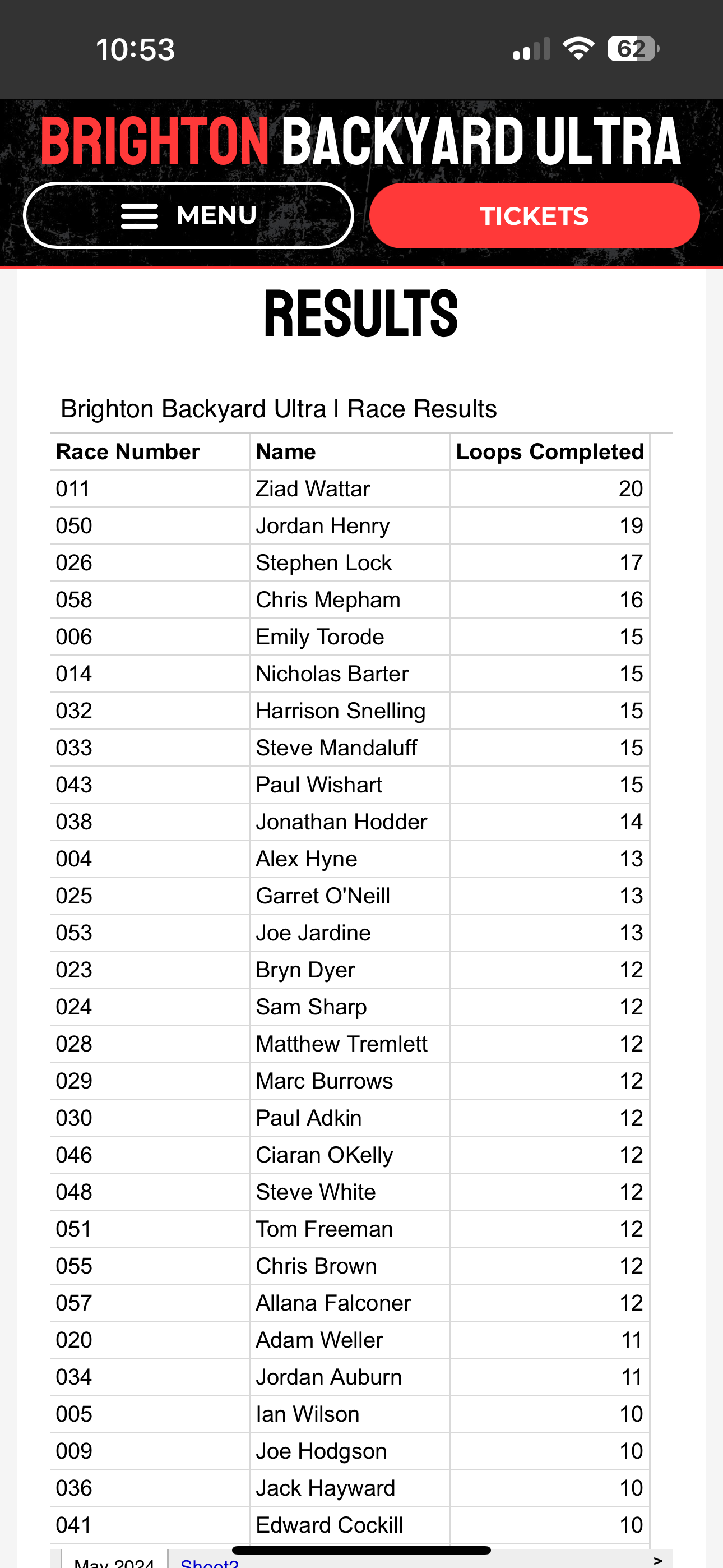
Zee went on to win this race with 20 loops (134km) completed. Which I had guessed he would. He looked so strong, and was so determined that he would do at least 24 loops, from so early on, that I feel bad that I didn’t stay to assist him. I had wrongly assumed there was one other 24 looper still on the course when I stopped in 4th place.
Mental game
After a while you get to know the course quite intimately, you don’t think in terms of kilometres completed but rely more on physical landmarks to guage distance travelled and markers for when to run and when to tab. These are the BBYU markers that I came up with:
- Walk at the steep hill
- Run from the first Up arrows sign, until I get to the gate to enter the woods
- Walk from the gate up to the first “Caustion runners” sign
- Run past the man-made pond on the right
- Run and hop over the fallen tree covering the entire footpath (don’t trip over it, for god’s sake)
- Run through cross road with “Caution runners” sign on it
- Run up to slight left bend where it gets very steep
- Walk until clear sight of the turn-around point (maybe 100 meters before, earlier loops I would arrive here at 30 minutes passed the hour, later loops I would arrive here at 25 minutes passed the hour)
- Run around turn-around point and all the way back to the start of the loop (earlier loops I would allow 17 minutes on average, later loops I would do this in around 15 minutes)
Thinking about these markers, what my admin will be at the end of this loop, how my body is feeling now, and interacting with the person who is running with me, takes up a lot of thought and time. It is impossible to be bored if you are thinking correctly, and sticking to your routine.

I went into this race knowing that looped courses have historically been my weakest format. I was determined to respect the course, to be smart, to be patient, and to be consistent with my nutrition and my pacing. I am so happy it came together.
I finished strong, in 4th place (out of 49 starters), with 16 loops (yards) completed, which is 107.2km.
I can easily recommend this format, as it is very inclusive. You are not racing others, you are pushing your own physical and mental limits. You decide what your goals are.
You are not constrained like in traditional, point-to-point, ultras. You can bring along as much food as you like, as many changes of clothes, and other home comforts. You don’t even need to carry anything.

Check out my run on strava: https://www.strava.com/activities/11389743992/overview
The Brighton backyard ultra official website: https://brightonbackyardultra.co.uk/
 Chris runs ultras
Leave a comment