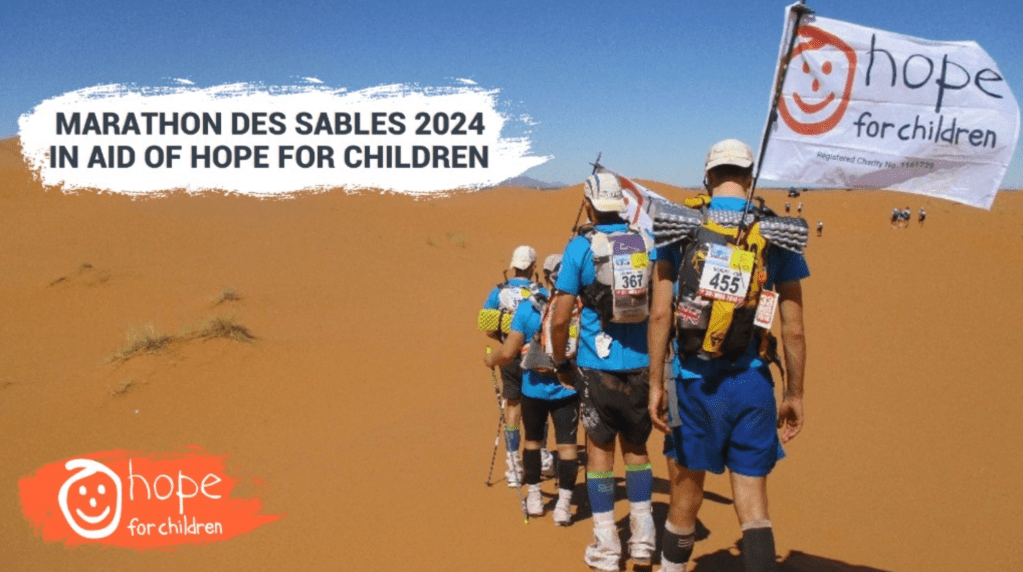
When I initially signed up to run the Marathon des Sables (MdS), it was for purely selfish reasons. I wanted to test my mental and physical capabilities of running a six-day, 250 km (160 mile) ultramarathon race in the Sahara Desert.
I had not intended to raise money for a charity, not because I am mean-spirited but because I have never done it before. To fundraise felt like an added task to organise and manage (in addition to all the running preparations).
However, when I was at the MdS expo in London in October 2023 I changed my mind. There were a range of charities represented with a good track record in supporting runners at the MdS and there were talks from former competitors who described their fundraising efforts and the impact it had on the charities.
It felt reassuring that there was an established blueprint and support for less experienced fundraising runners, like myself. I deliberated about what charity to choose and eventually settled on Hope for Children.
This felt particularly relevant, as my partner is currently pregnant with our first child. I am very aware of how privileged my child will be, to be born in a developed country with access to free healthcare, free education and employment opportunities.
Hope for Children supports vulnerable, overlooked and exploited children, living in extreme poverty. It currently works in five countries: Uganda, Sri Lanka, India, Kenya and the UK.
Hope for Children was founded in 1994 (coincidentally, the International Year of the Family) by Dr Bob Parsons OBE, in response to an event that had a profound impact upon him. In 1994, soon after retiring from the probation service, Dr Bob was asked by Save the Children to set up a Tracing Programme for orphaned and separated Rwandan children, as a result of the war (www.hope-for-children.org).
Whilst witnessing the horrors of genocide, Dr Bob also witnessed the humanity, compassion and resilience of the nation. He saw local people offering their homes to orphaned children and giving them the love and security they desperately needed.
Yet, many people struggled to cater for the growing number of children given their limited resources and impoverished conditions. At the time, Dr Bob reached out to established charities asking them to intervene, yet they all refused. It was then he decided to set up his own charity to support these families on a micro-level.
He wanted to help vulnerable children and their families with no other means of support. His vision was to remain small enough to be impactful at a grassroots level and to establish meaningful relationships with the local community to create sustainable solutions.
Hope for Children aims to create a stable economic future for the whole family and thus create a better life for the children. The charity recognises that the best place for a child to grow up is within their loving family. Supporting families to increase their household wealth means parents would no longer rely on their children to support the family income through working.
It also means they can afford their children’s schooling fees. By lending small amounts of money to local people, especially women, it enables them to start their own business and be employed. It champions an individual’s entrepreneurial aspirations.
Let’s take a case example: Fathima lives in Northern Sri Lanka with her husband and two children. Both Fathima’s son and daughter attend school, but as they get older it is becoming increasingly expensive. Fathima’s husband works as a casual labourer, but it is not enough to sustain the family. Fathima decided to lease the village cow and earn an income from selling its milk.
She then decided to take out a loan with the help of Hope for Children to buy a dairy cow for her family to continue to increase their household income (www.hope-for-children.org). This microeconomics approach supports parents to utilise their resourcefulness and determination through income-generation schemes.
Through the work of Hope for Children, I have been made aware of the gender gap in literacy skills and educational attainment in developing countries.
Most developed nations have an adult literacy rate of 96% or higher. Whereas, the least developed nations have an average literacy rate of only 65% and only a fraction of this percentage includes females (World Population Review, 2023). Approximately 11% of women in African and Indian communities have received sufficient education to read and write (www.cftw.org).
Additionally, those born in developing countries typically face more extreme climates and experience frequent natural catastrophes such as drought, floods, and famine.
I am very grateful that by being born in the UK, my daughter will have access to opportunities that girls in developing countries aren’t afforded.
I would be most grateful if you would support this very worthy cause and my MdS journey. To donate please visit my JustGiving page here:

By Emily Nash
 Chris runs ultras
Leave a comment